Hereditary Factor X Deficiency (HFXD) May Not Have Prolonged aPTT

Prevalence and PT/aPTT for congenital coagulation factor deficiencies4,5,13,14

Factor X deficiency lab values vary across patients. Some patients may present with prolonged PT and prolonged aPTT, while other patients may present with prolonged PT and normal aPTT14

Factor DeficiencyEstimated PrevalencePTaPTT
Rare Bleeding Disorders
Factor II (prothrombin)1 in 2 millionProlongedNormal or prolonged
Factor V1 in 1 millionProlongedProlonged
Factor VII1 in 500,000ProlongedNormal
Factor X1 in 500,000 to
1 in 1 million
ProlongedNormal or prolonged
Combined Factors V/VIII1 in 1 millionProlongedProlonged
Factor XI1 in 1 millionNormalProlonged
Factor XIII1 in 2 millionNormalNormal
More Common Bleeding Disorders
Factor VIII (Hemophilia A)1 in 5,000 male birthsNormalProlonged
Factor IX (Hemophilia B)1 in 30,000 male birthsNormalProlonged
von Willebrand Factor1 in 100 to 1 in 10,000NormalNormal or prolonged
Consider testing for factor X deficiency if a patient with bleeding symptoms has a prolonged PT. A single blood test can confirm HFXD
aPTT, activated partial thromboplastin time; PT, prothrombin time.

Testing for HFXD

Early diagnosis of hereditary factor X deficiency may allow for earlier initiation of appropriate care and treatment

If hemophilia and von Willebrand disease have been excluded in a patient with bleeding symptoms—

Rare bleeding disoder icon
The patient may have an underlying rare bleeding disorder, such as HFXD4,5
Prolonged prothrombin time (PPT) icon
Consider testing for HFXD if the patient’s prothrombin time (PT) is prolonged4,5,7
Factor X activity test icon
Confirm factor X deficiency using a single test (CPT code 85260): plasma assay for Factor X Activity7,15
Factor X activity low icon
For a patient with a lower-than-normal factor X assay result, use the factor X activity level to determine their Baseline Severity Classification8,16

HFXD Baseline Severity Classification

Understanding HFXD baseline severity classification and how it differs from hemophilia8,16-18

Factor X Baseline Severity Classification17
Determines bleeding risk based on baseline factor X activity (without treatment)
Based on analysis of registry data from the European Network of Rare Bleeding Disorders (EN-RBD) Group; included 45 patients with factor X deficiency out of 592 total patients with a rare bleeding disorder and a mean age of 31 years.8,17
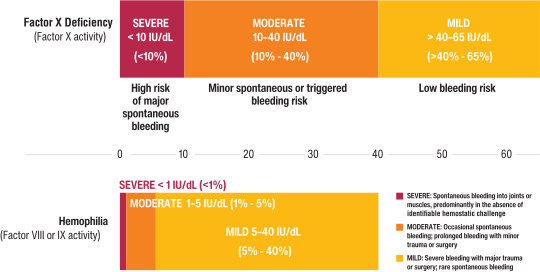
Baseline Severity Classification — Bleeding Risk Ranges for Factor X Deficiency and Hemophilia A8,16-18
Chart showing bleeding risk ranges for Factor X Deficiency and Hemophilia A
Factor X severity classification ranges differ markedly from hemophilia8,16-18

HFXD Clinical Bleeding Severity

Understanding HFXD clinical bleeding severity grades8

Factor X Clinical Bleeding Severity8

Assigns clinical bleeding grade based on documented bleeds*
From a cross-sectional study using EN-RBD data from 34 patients with HFXD.8
Clinical Bleeding Severity Grades and Factor X Activity7
(mean, 95% confidence interval [CI])
Chart showing Factor X activity and clinical bleeding severity
Grade III: Spontaneous major bleeding—hemarthrosis, CNS, GI, umbilical cord, intramuscular hematomas requiring hospitalization.
Grade II: Spontaneous minor bleeding—bruising, ecchymosis, minor wounds, oral cavity, epistaxis, menorrhagia.
Grade I: Bleeding after trauma or drug ingestion (antiplatelet or anticoagulant therapy).
Asymptomatic: No documented bleeding episodes.
Clinical bleeding severity strongly correlates with factor X activity level8
However, patients may vary in their bleed severity relative to factor X activity level, so ongoing monitoring for bleed occurrence is crucial8
*Bleeding episodes were classified into four bleeding severity categories relying on bleed location, potential clinical impact, and spontaneity; patients were assigned to a category if they had at least one documented bleeding episode matching the defined bleeding severity and no episode matching the higher severity grade. Linear regression analysis was performed, adjusting for age at data collection, sex, and center where diagnosis was made.
References: 1. National Institutes of Health. Doherty T, et al. Bleeding disorders. StatPearls [Internet]. https://www.ncbi.nlm.nih.gov/books/NBK541050/. Updated April 3, 2023. Accessed August 24, 2023. 2. LearnHaem, Haematology made simple. 4 Nov. 2020. Accessed October 2, 2025. https://www.learnhaem.com/courses/coagulation/lessons/normal-haemostasis/topic/the-revised-coagulation-cascade/. 3. Tarantino MD. Haemophilia. 2021;27(4):531-543. doi: 10.1111/hae.14223. 4. Kamal AH, et al. Mayo Clin Proc. 2007;82(7):864-873. 5. Palla R, et al. Blood. 2015;125(13):2052-2061. 6. Menegatti M, Peyvandi F. Thromb Hemost. 2024 Aug 29. doi: 10.1055/s-0044-1789595. Epub ahead of print. 7. Peyvandi F, et al. Blood Reviews. 2021;50:100833. 8. Peyvandi F, Palla R, et al. J Thromb Haemost. 2012;10:615-621. 9. Branchford B, et al. Blood Coagul Fibrinolysis. 2024;35(3):73-81. 10. Herrmann FH, et al. Haemophilia. 2006;12:479-489. 11. Byams V, et al. J Women’s Health. 2022;31(3):301-309. 12. Shapiro A. Expert Opin Drug Metab Toxicol. 2017;13(1):97-104. 13. National Organization for Rare Disorders. Updated June 6, 2023. Accessed October 25, 2024. https://rarediseases.org/rare-diseases/factor-x-deficiency/. 14. Medline Plus. https://medlineplus.gov/genetics/condition/von-willebrand-disease/#synonyms. Updated August 8, 2023. Accessed November 1, 2024. 15. LabCorp. https://www.labcorp.com/tests/086306/factor-x-activity. Accessed November 5, 2024. 16. Peyvandi F, et al. Brit J Haematol. 1998;102:626-628. 17. Peyvandi F, et al. J Thromb Haemost. 2012;10:1938-1943. 18. Srivastava A, et al. Haemophilia. 2020;26(Suppl 6):1-158. doi: 10.1111/hae.14046. 19. Medical and Scientific Advisory Council (MASAC) of the National Bleeding Disorders Foundation. MASAC Document #290. https://www.bleeding.org/healthcare-professionals/guidelines-on-care/masac-documents/masac-document-290- masac-recommendations-concerning-products-licensed-for-the-treatment-of-hemophilia-and-selected-disorders-of-the-coagulation-system. Accessed March 31, 2025. 20. Escobar M, Kavakli K. Haemophilia. 2024;30:59-67.
Replace exactly what's missing

Indications and Usage for COAGADEX

COAGADEX, a plasma-derived blood coagulation factor X concentrate, is indicated in adults and children with hereditary factor X deficiency for:

  • Routine prophylaxis to reduce the frequency of bleeding episodes
  • On-demand treatment and control of bleeding episodes
  • Perioperative management of bleeding in patients with mild, moderate and severe hereditary factor X deficiency

Contraindication for COAGADEX

COAGADEX is contraindicated in patients who have had life-threatening hypersensitivity reactions to COAGADEX.

Important Safety Information for COAGADEX

Allergic type hypersensitivity reactions, including anaphylaxis, are possible with COAGADEX. If symptoms occur, patients should discontinue use of the product immediately, contact their physician, and administer appropriate treatment.

The formation of neutralizing antibodies (inhibitors) to factor X is a possible complication in the management of individuals with factor X deficiency. Carefully monitor patients taking COAGADEX for the development of inhibitors by appropriate clinical observations and laboratory tests.

COAGADEX is made from human plasma and may contain infectious agents, e.g. viruses, the variant Creutzfeldt-Jakob disease (vCJD) agent and, theoretically, the Creutzfeldt-Jakob disease (CJD) agent. No cases of transmission of viral diseases, vCJD or CJD, have been associated with the use of COAGADEX.

In clinical studies, the most common adverse reactions (frequency ≥5% of subjects) with COAGADEX were infusion site erythema, infusion site pain, fatigue and back pain.

Please see complete Prescribing Information for COAGADEX.

You are encouraged to report negative side effects of prescription drugs to the FDA. Visit https://www.fda.gov/medwatch, or call 1-800-FDA-1088.
You may also call Kedrion at 1-866-398-0825 or email US_Medicalinfo@kedrion.com.