Routine prophylaxis

while taking twice-weekly prophylaxis


COAGADEX Has Proven Efficacy for Prophylaxis
Twice-weekly COAGADEX prophylaxis was studied in a 26-week, prospective, open-label, multicenter, non-randomized, phase III study in 9 children with hereditary factor X deficiency (HFXD); efficacy was assessed by investigators1
- All patients had a factor X activity level of <5 IU/dL at baseline and had been diagnosed within the first year of life
- 44% of patients were aged 2–5 years; 56% were aged 6–12 years
- 56% of patients were female
Patient Bleed History*
- Every patient had experienced 1 severe or serious bleed prior to study entry (circumcision bleed, umbilical stump bleed, cord bleed, intracranial hemorrhage, gastrointestinal bleed, or hematoma)
- Nine patients had a total of 21 bleeds recorded prior to study entry (per protocol definition)

Safety
- 28 adverse events (AEs) were reported in 8 study subjects; none of these AEs were considered treatment-related
- No evidence of inhibitor development was observed
Majority of Patients Achieved ZERO Bleeds with COAGADEX

7 of 9 patients (78%) with HFXD had ZERO BLEEDS requiring replacement therapy while taking twice-weekly prophylaxis1
In the 2 patients who experienced bleeds requiring treatment, a single dose of COAGADEX successfully treated each bleed1
Male aged 8 years:
- 3 spontaneous nose bleeds (2 major following exercise and 1 minor) were each treated with a single dose of COAGADEX
Female aged 11 years:
- Began menses shortly before study entry
- Major bleed (menorrhagic) was treated with a single dose of COAGADEX
Additional Key Findings
All subjects maintained trough levels >5 IU/dL after Visit 4 (Days 29-42)

IR was lower at each time point among patients aged 0-5 years compared with patients aged 6-11 years
Routine Prophylaxis Compared to On-Demand Use

Investigators rated and compared COAGADEX prophylaxis and on-demand efficacy in an open-label, long-term, multi-center, retrospective analysis including 15 children and adults with HFXD*2
- All patients were <5 IU/dL at baseline
- Patient age range was 1-43, with 2 patients <12 years
- 53% of patients were female
Patients who received COAGADEX as routine prophylaxis experienced a lower bleed rate than those who received on-demand treatment
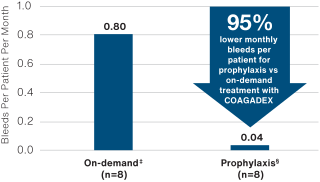
- †N=15 patients; 1 patient alternated between routine prophylaxis and on-demand and was counted in both groups for the analysis.
Safety Findings
- No adverse events, inhibitor development or thromboembolic events were reported in up to 4 years of treatment
- *Patients received COAGADEX as compassionate use.
- ‡On-demand: Efficacy was assessed for each bleed retrospectively.
- §Routine prophylaxis: Evaluation included average number of bleeds per year and per month (considering severity, location, and cause) and total dose per year and per month.
- ¶Overall efficacy assessed retrospectively by investigator.


Indications and Usage for COAGADEX
COAGADEX, a plasma-derived blood coagulation factor X concentrate, is indicated in adults and children with hereditary factor X deficiency for:
- Routine prophylaxis to reduce the frequency of bleeding episodes
- On-demand treatment and control of bleeding episodes
- Perioperative management of bleeding in patients with mild, moderate and severe hereditary factor X deficiency
Contraindication for COAGADEX
COAGADEX is contraindicated in patients who have had life-threatening hypersensitivity reactions to COAGADEX.
Important Safety Information for COAGADEX
Allergic type hypersensitivity reactions, including anaphylaxis, are possible with COAGADEX. If symptoms occur, patients should discontinue use of the product immediately, contact their physician, and administer appropriate treatment.
The formation of neutralizing antibodies (inhibitors) to factor X is a possible complication in the management of individuals with factor X deficiency. Carefully monitor patients taking COAGADEX for the development of inhibitors by appropriate clinical observations and laboratory tests.
COAGADEX is made from human plasma and may contain infectious agents, e.g. viruses, the variant Creutzfeldt-Jakob disease (vCJD) agent and, theoretically, the Creutzfeldt-Jakob disease (CJD) agent. No cases of transmission of viral diseases, vCJD or CJD, have been associated with the use of COAGADEX.
In clinical studies, the most common adverse reactions (frequency ≥5% of subjects) with COAGADEX were infusion site erythema, infusion site pain, fatigue and back pain.
Please see complete Prescribing Information for COAGADEX.
You are encouraged to report negative side effects of prescription drugs to the FDA. Visit https://www.fda.gov/medwatch, or call 1-800-FDA-1088.
You may also call Kedrion at 1-866-398-0825 or email US_Medicalinfo@kedrion.com.